Bulk YouTube Transcript Extraction for AI Pipelines: What Breaks at Scale.
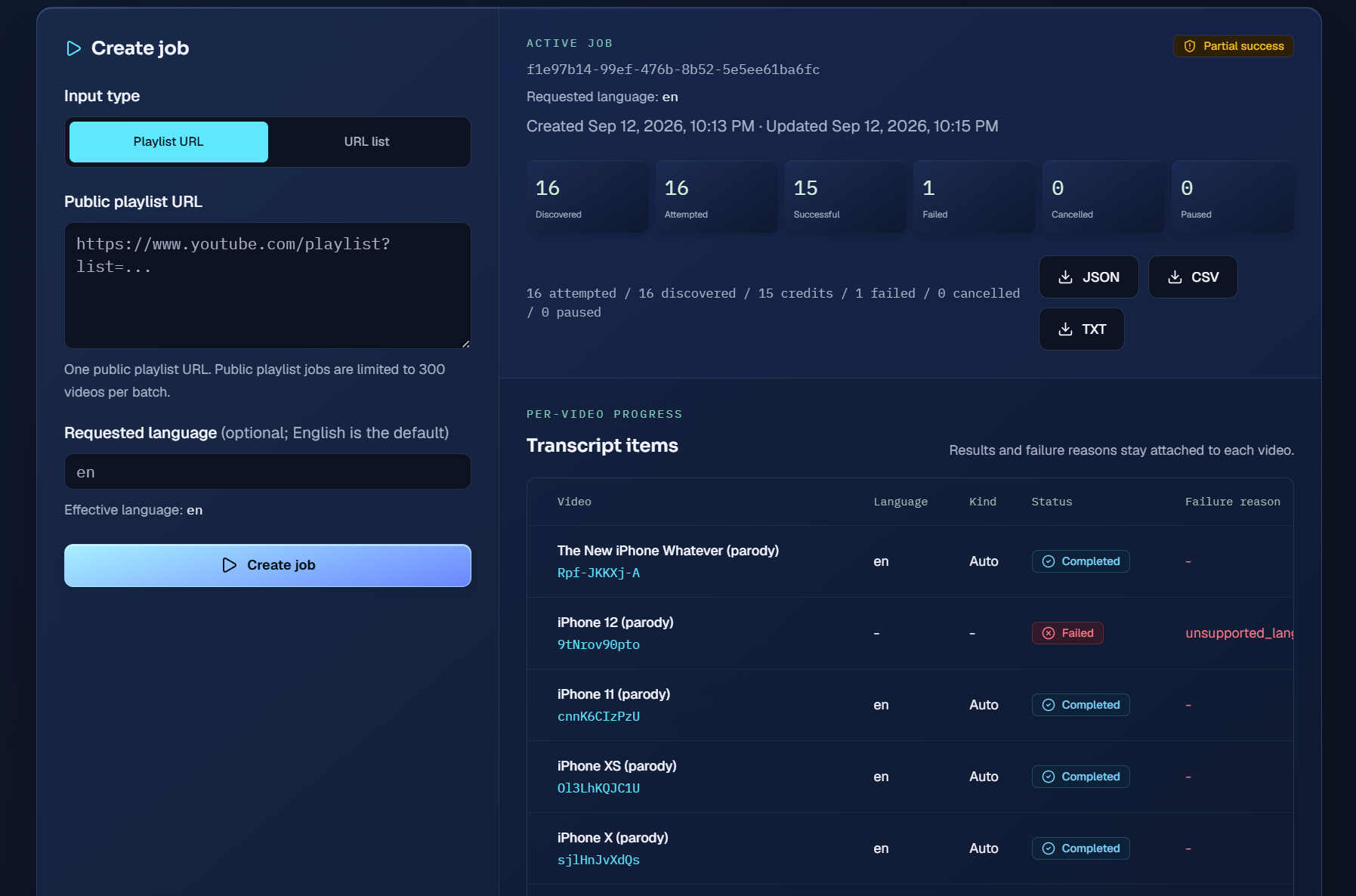
One practical note: audit for private and age-restricted videos before submitting. They always fail at fetch time. Filtering them first saves credits and job slots.
Export JSON first. Derive the rest.
JSON with per-segment timestamps is the master format. Timestamps let you align text with audio, slice time windows, and chunk at natural pause boundaries instead of arbitrary character counts. A useful record carries video ID, title, language, and segments with start and end times.
CSV fits analysts and warehouse loads: one row per segment, flat and queryable. TXT fits fine-tuning runs that want bare text. Both derive from JSON in seconds. The reverse is impossible, timestamps lost from TXT never come back. If you only keep one format, keep JSON.
Deduplication and caption quality
Two levels. Video-level dedup (same ID twice) is table stakes and belongs in the extractor. Near-duplicate detection (re-uploads, mirrors, same lecture on two channels) needs text similarity and matters once your corpus passes a few thousand transcripts. Below that, skip it.
Auto captions deserve suspicion proportional to your use case. Accents, technical vocabulary, and fast speech all degrade them. Where it matters, prefer manual tracks or score quality afterward with cheap proxies like punctuation density. For large corpora, accept auto captions and filter, rather than chasing perfection per video.
Three ways to do this
| Approach | Fits | Catches |
|---|---|---|
| DIY Python scripts | One-off research, a few hundred videos, strong Python skills | No dedup, breaks on YouTube changes, hand-rolled rate limits, no job state |
| General scraping platforms | Teams already paying for scrape infra | Weak transcript structure, ragged timestamps, per-run costs stack up |
| Dedicated bulk transcript tools | Recurring pipelines, multi-format output, anyone who wants job tracking without building it | Account plus credits, less custom logic |
I started with option one and moved off it when maintaining the extractor cost more than the transcripts were worth. That crossover lands around a few hundred transcripts a month, recurring.
I eventually shipped my version as TranscriptBatch, which does the playlist-in-one-call flow above, plus a REST API for the same jobs from code. Python and Node samples live on GitHub.
Feeding it into a pipeline
For RAG, chunk on timestamp gaps, not character counts. A chunk that ends mid-sentence retrieves badly; a chunk aligned to a speaker pause holds meaning. For fine-tuning, strip filler and non-speech markers, drop sub-200-word transcripts, and keep the metadata fields your filters need. For vector stores, map video ID, title, language, and timestamps straight onto document metadata so hits link back to exact moments.
Rate limits will find you
YouTube throttles bulk fetching. The only sustainable answer I found: pace every request (mine go out 1500ms apart, never two at once), back off exponentially on 429s, log per-video errors instead of aborting the batch, and checkpoint so a dead run resumes instead of restarting. Silent partial failures are the nightmare scenario, a dataset you believe is complete but is not, surfacing weeks later in eval. Loud per-video errors plus resume beats quiet optimism every time.
Quick answers
Manual or auto captions for training? Manual where available. Auto at scale with a quality filter after.
Videos with no captions? Expected failures. Log the IDs, finish the batch, route leftovers to ASR separately if they matter.
One call for a whole playlist? Yes, with dedup and one export at the end. That is the entire point of batch design.
JSON, CSV, or TXT for vectors? JSON. The metadata maps onto document fields directly.